|
|
|
|
|
|
|
|
|
We are frequently asked to recommend books for more information on data storage, flash memory, signal processing, detection, and error correction coding. The following are brief thoughts on several popular titles. However, the most current technical information is usually found in journals, trade magazines, newspapers, and, to a lesser extent, patents. ChannelScience has an affiliate program with Amazon. Just click on a book jacket below to go directly to their site to place your order. If you place the order by clicking through from this page, we get a small referral fee. However, this does not affect your price. We chose Amazon after comparing several sources on availability, delivery speed and price of the titles we mention here. However, if you would like to verify that you are getting a good price Nextag compares many retail sites and lists the available prices (we do not get a referral fee from Nextag). Be aware that sometimes the lowest price provider does not have very efficient shipping or customer service. Authors: If you would like ChannelScience to add a quick review of your book to the table below, send a copy of the book to ChannelScience ATTN: Book Reviews; 7300 Cody Court; Plano TX 75024-3839 USA.
You can also contact ChannelScience by email or phone.
|
|
|
|
Book Information
|
Book Description
|
 
|
Beautiful Evidence,
ISBN: 0961392177 Tufte, Edward R. Published by Graphics Press Date Published: 07/2006
|
Fourth of four books (see below) by Edward Tufte on communicating data graphically. If you make presentations, create charts, tables and graphs, or design user interfaces or websites, you need to expose yourself to his research and ideas.
Describes how to improve word/image relationships in your work. Graphics should honestly convey causation.
|
|
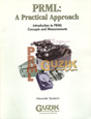
Characterization of Magnetic Recording Systems: A Practical Approach (an extension of "PRML: A Practical Approach, Introduction to PRML Concepts and Measurements," published in 1995) Taratorin, Alexander Guzik Technical Enterprises Guzik Part Number: 99-900000-01
|
Alex Taratorin, a well-respected researcher, has written the only book we have found that tries to address the basics of what one sees at the spin-stand tester.
Pro: Most of the common phenomena one encounters in standard PRML channels is well described. Con: Needs to be updated to reflect current channels and heads. May be too math-intensive to serve as an introduction.
|
|
|
|
|
|
|
Coding and Signal Processing for Magnetic Recording Systems,
ISBN: 9780849315244 Edited by Vasic, Bane and Kurtas, Erozan M. Published by CRC Press Date Published: 07/2004
|
This is a collection of chapters from different authors on a wide range of topics in magnetic storage read channels.
Pro: Most of the topics-of-interest for read channels are covered. In addition, there are sections on servo systems and controller functionality.
Con: Because the chapters are by so many different authors, the book does not have one familiar style or a tight non-repetitive flow. At times, opportunities to provide insight are skipped, perhaps this is to protect confidential information.
|
|
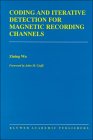
Coding and Iterative Detection for Magnetic Recording Channels,
ISBN: 0792377176 Wu, Zining Published by Kluwer Academic Publishers Date Published: 2000
|
This book grew out of the Ph.D. dissertation of one of Prof. John Cioffi's students. It is the first book that we know of that covered turbo coding, turbo equalization and low-density parity check codes for data storage.
Pro: Concise well-written chapters get to the heart of each matter.
Key aspects of modern hard disk drive read channels are described
in one place.
Con: Not an introduction to turbo codes or magnetic recording. Opportunities
to provide insight are sometimes skipped.
|
|
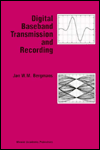
Digital Baseband Transmission and Recording,
ISBN: 0792397754 Bergmans, Jan W. M. Published by Kluwer Academic Publishing Date Published: 06/1996
|
This is Chuck's favorite college/grad-level textbook on hard disk drive read channel detection. It is also the ONLY college/grad-level textbook on the subject.
Pro: Very complete and authoritative. Includes many practical considerations. Con: A lot of math to go through to get the practical advice. Quickly dated -- no post-processors, turbo codes, LDPC, or 2D detection.
|
|
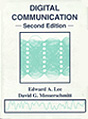
Digital Communication, 2nd Edition,
ISBN: 0792393910 Lee, Edward A. / Messerschmitt, David G. Published
by Kluwer Academic Publishing Date Published: 01/1994
|
Considered by many as the standard reference for digital communications (note, the read channel is considered a baseband digital communication system).
Pro: Clear and complete. Best index Chuck has seen. A great book Con: No examples directly related to data storage read channels. Non-electrical engineers will probably have trouble getting useful information from the book.
NOTE: 3rd edition is available (published in September 2003), but Chuck has not reviewed it. The fundamentals in the 2nd edition are solid.
|
|
 
|
Digital Communications 4th Edition,
ISBN: 0072321113 Proakis, John G. Published
by McGraw Hill Companies Date Published: 08/15/2000
|
Useful as a companion reference book to Lee and Messerschmitt listed herein. It provides a different perspective on most of the same topics. Author is quite famous in digital communications.
Pro: Complete and authoritative. Good alternative perspective on communications issues. Con: No examples directly related to data storage read channels. Non-electrical engineers will probably have trouble getting useful information from the book.
NOTE: 5th edition is available (published in November 2007), but Chuck has not reviewed it.
|
|
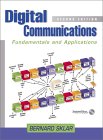
Digital Communications: Fundamentals and Applications 2nd Edition,
ISBN: 0130847887 Sklar, Bernard Published
by Prentice Hall Date Published: 01/11/2001
|
ANOTHER useful companion reference book to Lee and Messerschmitt listed herein. It is more of an introductory text, but still is only for electrical engineers.
Pro: A very good value. Good insight offered throughout. Includes a good introductory section to turbo codes. Comes with SystemView simulation software by Elanix(R). Con: No examples directly related to data storage read channels. The turbo code section only covers the most basic issues
|
|
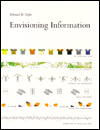
Envisioning Information,
ISBN: 0961392118 Tufte, Edward R. Published
by Graphics Press Date Published: 04/1990
|
Second of four books by Edward Tufte on communicating data graphically. If you make presentations, create charts, tables and graphs, or design user interfaces or websites, you need to expose yourself to his research and ideas.
Use multiple dimensions properly, steal ideas from Galileo, learn by example from a visually superb book.
|
|
 
|
Error Control Coding, 2nd Edition,
ISBN: 0130426725 Lin, Shu / Costello, Daniel J. Jr. Published
by Pearson Prentice Hall Date Published: 06/2004
|
This is an update of a very thorough, classic ECC text. Its style is more of an engineering approach, than a pure mathematics approach (but there is plenty of math).
Pro: About 100 pages on turbo codes and 100 pages on LDPC codes have been added. Iterative detection is also covered. Con: It is not storage-focused.
|
|
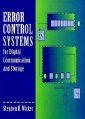
Error-Control Systems for Digital Communication and Storage,
ISBN: 0132008092 Wicker, Stephen B.
Published by Prentice Hall Date Published: 07/1994
|
This dense book quickly but thoroughly covers a broad range of fundamental ECC topics, with occasional examples for storage applications (more examples are for communications applications).
Pro: Contains practical implementation information that is hard-to-find elsewhere Con: LDPC or iterative techniques are not covered. It is not sufficiently clear to be used as an introduction to ECC.
|
|
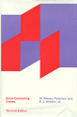
Error-Correcting Codes, 2nd Edition,
ISBN: 0262160390 Peterson,
William Wesley / Weldon, E.J. Jr.
Published by MIT Press Date Published: 08/1972
|
This classic book is often cited in discussions of ECC. It deserves a place on the bookshelf of everyone involved with error correction codes.
Pro: Classic reference. Complete and well-regarded. Con: No direct data storage ECC examples. The information and concepts are buried in dense text and extensive linear algebra.
|
|
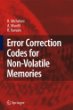
Error Correction Codes for Non-Volatile Memories,
ISBN: 9048178649Micheloni, R. / Marelli, A. / Ravasio, R.
Published by Springer Science and Business Media Date Published: 2008
|
This book was the first and only available that specifically addressed ECC for flash memory.
Pro: Good introduction to the inner workings of NOR and NAND flash, including error mechanisms. Hamming, Reed-Solomon, and BCH codes are covered. Con: Complicated sections suffer from lack of clarity, possibly due to being a translation from Italian. Flash moves so quickly that the NVM-specific material is dated. No LDPC and no signal processing.
|
|
|
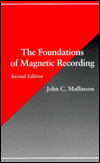
The Foundations of Magnetic Recording, 2ndEdition,
ISBN: 0124666264 Mallinson, John C. Published
by Academic Press Date Published: 02/1993
|
John Mallinson is an industry veteran who writes good, concise books for the practicing engineer.
Pro: Covers all the basic physics. Short, meaty chapters. Con: The examples are more relevant to tape recording systems than to current hard disk drives. No mention of MR heads. (Note, these comments are based on the 1st edition from 1987.)
|
|
Inside NAND Flash Memories, 1st Edition,
ISBN: 904819430XMicheloni, R. / Crippa, L. / Marelli, A. Published
by Springer Date Published: 08/2010
|
This book addresses almost all relavent topics for NAND flash, as of about 2010.
Pro: The authors and editors provide detailed information on many aspects of NAND flash cells, circuitry, and controllers that is very difficult to find elsewhere. It has earned its place on the reference bookshelf. Con: 3D NAND, sub-20nm changes, and signal processing advances are not covered sufficiently for the current needs. The binding of Chuck's hardback copy broke after minimal use.
|
|
|
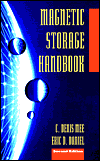
Magnetic Storage Handbook, 2nd Edition,
ISBN: 0070412758 Mee, C. Denis / Daniel, Eric D Published
by McGraw Hill Date Published: 08/1996
|
This often-cited reference contains a good overview of most types of magnetic storage systems (hard disk, floppy, tape, instrumentation, etc.).
Pro: Broad coverage. Rare information on ECC for data storage. Includes excerpts from some of Chuck's published work ;-)! Con: The hard disk drive industry moves so quickly that the material is dated rapidly.
|
|
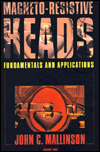
Magneto-Resistive Heads : Fundamentals and Applications: Electromagnetism Series,
ISBN: 0124666302 Mallinson, John C. Published
by Academic Press Date Published: 09/1995
|
John Mallinson is an industry veteran who writes good concise books for the practicing engineer.
Pro: A one-stop source for the basic physics of (G)MR heads. Short, meaty chapters. Key concepts not obscured by deep math. Con: Needs updating to include more practical problems of GMR heads and some of the newer head structures. A chapter on preamp issues and read channel head anomaly compensation schemes would be a great addition.
|
|
Noise in Digital Magnetic Recording,
ISBN: 9810208650 Arnoldussen, T. C. / Nunnelley, L. L. Published
by World Scientific Publishing Date Published: 08/1992
|
A college-level textbook on media noise.
Pro: A broad, deep reference on media noise and media modeling. Con: The material is dense and assumes the reader has good math and physics skills
|
|
Practical Error Correction Design for Engineers (2nd Edition),
ISBN: 0927239000 Glover, Neal and Dudley, Trent Published
by Cirrus Logic Date Published: 08/1999
|
This is a rare ECC text in that its 465 pages provide practical ECC implementation details.
Pro: Authoritative, practical, direct. Provides hard-won insights from early hard disk drive ECC implementations. Points out common, as well as subtle, hardware issues. Con: Very hard to get -- it is out-of-print. Does not include LDPC or turbo codes. Typeface and layout of equations, symbols, tables, and figures are inconsistent in places.
|
|
|
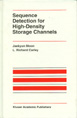
Sequence Detection for High-Density Storage Channels,
ISBN: 0792392647 Moon, Jaekyun / Carley, L. Richard Published
by Kluwer Academic Publishing Date Published: 08/1992
|
Jae Moon and Rick Carley are well known in hard disk drive data detection circles. They have made many contributions to the state-of-the-art.
Pro: If you need to model or mathematically describe read channel detection methods, this book is a useful guide. Con: Dated because of an emphasis on feedback detectors (such as FDTS/DF), that the industry did not embrace.
|
|
|
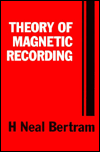
Theory
of Magnetic Recording,
ISBN: 0521449731 Bertram, H. Neal Published
by Cambridge University Press Date Published: 03/1994
|
College-level textbook for those who want to take their understanding of recording physics to a deeper mathematical level.
Pro: Complete and authoritative for modelers. Describes the physics and math of most magnetic recording phenomena. Con: Get ready for triple integrals!
|
 
|
Turbo Codes: Principles and Applications,
ISBN: 0792378687 Vucetic, Branka / Yuan, Jinhong Published
by Kluwer Academic Publishers Date Published: 06/2000
|
A good textbook for turbo codes and iterative detection.
Pro: Complete (as of 2000), well-written and insightful. Con: All but the most fundamental material is bound to be dated quickly in this incredibly rapidly developing field. A strong math background is a prerequisite and familiarity with ECC concepts is assumed.
|
|
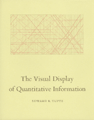
The Visual Display of Quantitative Information,
ISBN: 096139210x Tufte, Edward R. Published
by Graphics Press Date Published: 11/1983
|
First of four books by Edward Tufte on communicating data graphically. If you make presentations, create charts, tables and graphs, or design user interfaces or websites, you need to expose yourself to his research and ideas.
Get rid of "chart junk," maximize your data to ink ratio, facilitate decision making.
|
|
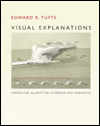
Visual
Explanations : Images and Quantities, Evidence and Narrative
ISBN: 0961392126 Tufte, Edward R . Published
by Graphics Press Date Published: 03/1997
|
Third of four books by Edward Tufte (see above).
Borrow from art, nature and magic. The section on the space shuttle Challenger will make you forever look at data differently. Did you know that the night before the explosion, the engineers tried to stop the launch because they thought the O-rings would fail? This tragically shows, when it comes to data, its not only what you say but how you say it.
|
|
|
|
|
|
|
|
|




