|
|
|
|
|
|
MATLABŪ is a mathematical software package from The MathWorks. It is the most popular language for prototyping read channel simulations, as well as many other signal processing applications.
This interpreted language is the tool-of-choice because it has powerful signal processing capabilities built-in and is relatively easy-to-use. For example, what might take new modules of code in other languages can often be completed in a single line with MATLABŪ. Plus, the built-in functions are typically very well tested and robust.
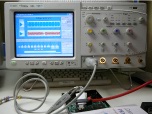
ChannelScience has created MATLABŪ software to control test equipment and to analyze the results returned. This includes oscilloscopes from Agilent and arbitrary waveform generators from Tektronix.
The benefits of prototyping algorithms and code in MATLABŪ include:
|
|
 A vast library of tested functions for signal processing, A vast library of tested functions for signal processing,
Great visualization and graphing tools that are very simple to use and to integrate into documentation,
A large and active user community, and
The ability to code at a higher level so that experimenting with new algorithms is much less time consuming.
|
|
However, there are some drawbacks with using MATLABŪ. These include:
|
|
In order for someone else to use code you develop, they must also have a license for MATLABŪ,
For some algorithms ChannelScience has created, our C/C++ versions run 50 to 80 times faster than interpreted MATLABŪ,
Integrating C/C++ routines with MATLABŪ for the first time can be very difficult, and
Although it is possible to compile a standalone version of MATLABŪ code you create, this requires the developer to purchase the MATLABŪ Compiler from The MathWorks; Distribution of the resulting executable must include a run-time library that is larger than 100MB.
|
|
We hope you find this perspective on MATLABŪ helpful. ChannelScience believes that MATLABŪ is a fantastic tool for signal processing and for sophisticated data visualization.
If MATLABŪ is price-prohibitive for your application, you might want to try NumPy, which is a free package for scientific computing in Python, or Octave.
ChannelScience can assist you with a wide range of MATLABŪ software development tasks, including migrating portions of your existing code from MATLABŪ to C/C++, or from C/C++ to MATLABŪ.
Please contact ChannelScience to discuss your programming projects, or for a free initial consultation.
|
|
|
|
|
|
|
|